Discover Nikkei Logo

https://www.discovernikkei.org/en/interviews/clips/538/

Insights from family on Japanese American internment

My dad told me about internment a long time ago. I think he told me really early. I know that when he told me, I didn’t quite grasp it. I was too young or at that point too interested in other things to be able to really understand the concept fully. And you’ll see as you get a little bit older. You’ll start to see it in history books, in school and whatnot. And you know, they devote…what do they devote? Like a half a page. You know, there’s a big picture of Pearl Harbor and this whole thing about how awful that was and then there’s a little thing about internment like in there somewhere.

And at that point, I think it struck me like, “That’s weird. Why don’t they…like my dad told me all about that and it’s weird that they didn’t really talk about it.” And I know over time…you know, I didn’t go on any big crusade to figure it out or anything. I think just over time, the collection of information happened and I started asking…I’d ask my relatives every once in a while. I’d ask people and the funny thing is they wouldn’t tell me. They’d give me such a watered down answer as to what their internment experience was. I think that that bothered me because of the “it-can’t-be-helped” attitude, the shikata ga nai attitude is so…it was so useful back then but these days, in my opinion right now, I just don’t…I think that that for my generation has been a little bit of…it’s been a little bit of a detriment, a little bit of a…like something that we personally wish that our older relatives and our elders would put aside to a certain degree so that we can learn about the story.

And so when I was making this Fort Minor record, my new record, it is like more of a solo kind of a project. It is more of a focus on my experiences mixed with my creative ideas. I’m making all the music, producing every song, mixing every song, and then lyrically, I wanted to get in some things that were my own. So I got into that subject a little bit, did an interview with my dad, who’s the second to youngest of 13. I mean they’re not all alive any more but 13 kids. And my aunt, who’s the oldest. So it’s the 2 perspectives. He was like 3 years old. She was in her 20s when…during the 40s when they were interned and I got…I think I got some really great insight into what happened.


Fort Minor (band) imprisonment incarceration music World War II camps

Date: Jan 16, 2006

Location: California, US

Interviewer: Chris Komai and John Esaki

Contributed by: Watase Media Arts Center, Japanese American National Museum

Interviewee Bio

Michael Kenji Shinoda was born and raised in Agoura Hills, a suburb north of Los Angeles, to a Japanese American father and Caucasian mother. He first began studying music with piano lessons at age three. During high school and continuing while a student at Art Center College of Design in Pasadena, California, Shinoda and friends formed a band called Xero. Due to copyright issues, they later renamed themselves Hybrid Theory and ultimately, Linkin Park. Since the 2000 release of their first album, Linkin Park has enjoyed great success. In 2002, they won a Grammy for “Best Hard Rock Performance” for their song “Crawling.” The band won another Grammy in 2006 for their mash-up collaboration with Jay-Z entitled “Numb/Encore.”

In 2005, Shinoda released his first solo effort, The Rising Tied, a hip-hop album that he wrote and produced under the name Fort Minor. One of the songs on the debut album titled “Kenji” was inspired by a visit to the Japanese American National Museum. He interviewed family members who were incarcerated in American concentration camps during World War II. Parts of the interviews with his father and aunt are incorporated into the song.

Although he pursued music as his career, Shinoda continues to express his creativity visually. He oversees the design and artwork for all of Linkin Park’s printed and web materials. He has also created artwork for Linkin Park and Fort Minor’s album covers.

Despite his many projects, Shinoda has taken time to support many charities. In addition to starting a scholarship at Art Center College of Design, he has been involved with organizations like United Way, Denshō, Make-A-Wish Foundation, and the Japanese American National Museum. He participated in Los Angeles’ Nisei Week Parade as the 2005 Honorary Parade Marshal. For his creative contributions to American culture, he was awarded the Japanese American National Museum’s Award of Excellence in 2006. (October 19, 2006)

Peggie Nishimura Bain
en
ja
es
pt
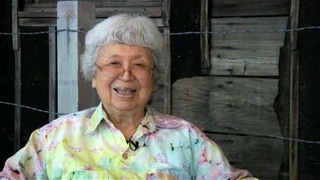
Peggie Nishimura Bain

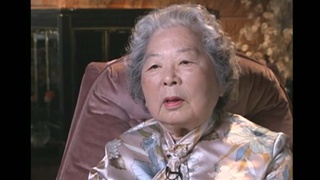
Evacuation

(b.1909) Nisei from Washington. Incarcerated at Tule Lake and Minidoka during WWII. Resettled in Chicago after WWII
en
ja
es
pt
Peggie Nishimura Bain
en
ja
es
pt
Peggie Nishimura Bain

Conditions at Pinedale Assembly Center

(b.1909) Nisei from Washington. Incarcerated at Tule Lake and Minidoka during WWII. Resettled in Chicago after WWII
en
ja
es
pt
Peggie Nishimura Bain
en
ja
es
pt
Peggie Nishimura Bain

Making craft items from shells found at Tule Lake

(b.1909) Nisei from Washington. Incarcerated at Tule Lake and Minidoka during WWII. Resettled in Chicago after WWII

en
ja
es
pt
Peggie Nishimura Bain
en
ja
es
pt
Peggie Nishimura Bain

Response to loyalty questionnaire

(b.1909) Nisei from Washington. Incarcerated at Tule Lake and Minidoka during WWII. Resettled in Chicago after WWII

en
ja
es
pt
Peggie Nishimura Bain
en
ja
es
pt
Peggie Nishimura Bain

Move from Tule Lake to Minidoka

(b.1909) Nisei from Washington. Incarcerated at Tule Lake and Minidoka during WWII. Resettled in Chicago after WWII

en
ja
es
pt
Peggie Nishimura Bain
en
ja
es
pt
Peggie Nishimura Bain

Apprehension about leaving camp

(b.1909) Nisei from Washington. Incarcerated at Tule Lake and Minidoka during WWII. Resettled in Chicago after WWII

en
ja
es
pt
Seiichi Tanaka
en
ja
es
pt
Seiichi Tanaka

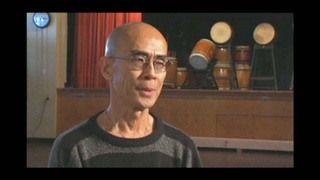
Soukou Bayashi: Dedicated to the Issei (Japanese)

(b.1943) Shin-issei grand master of taiko; founded San Francisco Taiko Dojo in 1968.

en
ja
es
pt
Seiichi Tanaka
en
ja
es
pt
Seiichi Tanaka

Taiko philosophy (Japanese)

(b.1943) Shin-issei grand master of taiko; founded San Francisco Taiko Dojo in 1968.
en
ja
es
pt
Etsuo Hongo
en
ja
es
pt
Etsuo Hongo

First taiko performance in the United States (Japanese)

(1949 - 2019) Taiko player. Founded five taiko groups in Southern California

en
ja
es
pt
Etsuo Hongo
en
ja
es
pt
Etsuo Hongo

Promoting group identity through taiko contests (Japanese)

(1949 - 2019) Taiko player. Founded five taiko groups in Southern California

en
ja
es
pt
Etsuo Hongo
en
ja
es
pt
Etsuo Hongo

Taiko's sounds as Japanese cultural tradition (Japanese)

(1949 - 2019) Taiko player. Founded five taiko groups in Southern California

en
ja
es
pt
Richard Kosaki
en
ja
es
pt
Richard Kosaki

442 soldiers visiting U.S. concentration camps

(b. 1924) Political scientist, educator, and administrator from Hawai`i

en
ja
es
pt
Roger Shimomura
en
ja
es
pt
Roger Shimomura

Receiving a negative reaction from father upon asking about World War II experience

(b. 1939) Japanese American painter, printmaker & professor
en
ja
es
pt
Frank Yamasaki
en
ja
es
pt
Frank Yamasaki

Loss of happy-go-lucky adolescence in Puyallup Assembly Center

(b. 1923) Nisei from Washington. Resisted draft during WWII.

en
ja
es
pt
Frank Yamasaki
en
ja
es
pt
Frank Yamasaki

Memories of dusty conditions at Minidoka incarceration camp

(b. 1923) Nisei from Washington. Resisted draft during WWII.
en
ja
es
pt

Discover Nikkei Updates

NIMA VOICES
Episode 19
Guest host Tamlyn Tomita chatted with actor Christopher Sean in the latest episode of Nima Voices about his background, acting, and community involvement.
WATCH NOW!
VIRTUAL PROGRAM
Nikkei Uncovered V: a poetry reading
Tuesday, December 9
Hosted by traci kato-kiriyama. Featuring Aaron Caycedo-Kimura, Erica Isomura, and Syd Westley
SUPPORT THE PROJECT
Discover Nikkei’s 20 for 20 campaign celebrates our first 20 years and jumpstarts our next 20. Learn more and donate!